

Ghost Cases and True Crime
When a case doesn't fit any trope, you won't hear about it.

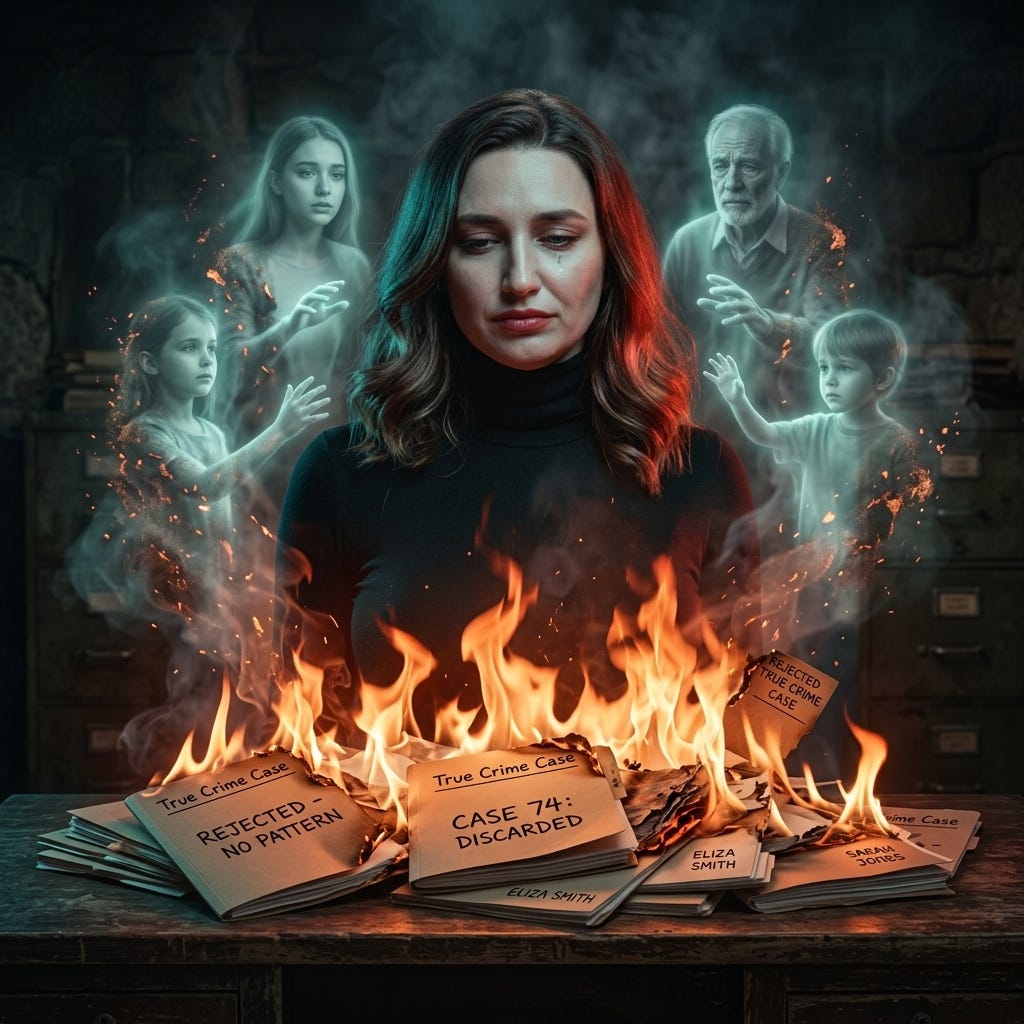
1. Opening: Defining “ghost cases”
Alexandra: When people think about true crime, they imagine that every major case is just waiting for a Netflix deal. The reality is darker. There are whole categories of cases that never even get considered for that pipeline, not because they’re unimportant, but because they don’t tick the right narrative boxes.
Perplexity: You call them “ghost cases”—cases that matter to families, communities, and sometimes entire regions, but are invisible in the industrial true‑crime story machine.
Alexandra: Exactly. They haunt the local memory, they sit in police files and family scrapbooks, they may have good reporting or a book behind them, but they never become “content” in the way audiences are trained to expect.
2. The invisible checklist
Alexandra: When I worked on television true crime, there was always a checklist, even if no one called it that. You needed a neat arc, at least a few “suspects,” emotional interviews, usable photos and footage, and preferably a satisfying ending. No twist, no suspects, no photogenic material? The case quietly died in development.
Perplexity: Industry guides are blunt about this: pick “multi‑faceted stories” with strong characters, “never‑before‑seen” material, and hook‑y twists, because that’s what sells. That automatically sidelines cases that are forensically complex but visually or narratively “flat.”
Alexandra: The result is a shadow archive of crimes that fail the entertainment test, not the public‑interest test. Those are the ghost cases.
3. The “wrong” victims and communities
Alexandra: One big category of ghost cases is about who the victim is. If you’re white, young, “innocent,” and photogenic, the industry knows how to market you. If you’re Indigenous, racialized, a sex worker, homeless, or struggling with addiction, suddenly the case is “too complicated,” “too heavy,” or “not relatable enough.”
Perplexity: That maps onto what ethicists keep pointing out: true crime systematically underrepresents crimes against marginalized people, especially when their lives don’t fit a sentimental narrative, and overrepresents cases where the victim can be framed as a stand‑in for the presumed audience.
Alexandra: And when those cases do get told, it’s often in niche podcasts or local reporting rather than big, glossy productions. For most viewers, they might as well not exist.
4. The “wrong” kind of story structure
Alexandra: Another category: the “wrong” kind of story. If there’s one obvious suspect from day one and the work is in proving it, that’s a chase, not a puzzle. If the case is unsolved, there’s no cathartic arrest montage. If the investigation reveals more about systemic failure than about a single monster, there’s no simple villain to package.
Perplexity: Industry advice leans toward what you might call “resolution‑ready” cases: tidy arcs, clear reveals, narrative closure. Ghost cases are the opposite—open‑ended, structurally messy, or deeply institutional.
Alexandra: But from a civic perspective, those are often the ones we most need to talk about.
5. The half‑visible: Forest City Killer
Alexandra: The Forest City Killer cluster in London, Ontario is a perfect example of a half‑visible ghost case. You have multiple victims in the 1960s, a suspected serial offender, decades of investigative work, and a modern cold‑case researcher, Vanessa Brown, reconstructing the files and arguing that one killer may link several murders.
Perplexity: There’s a substantial book, an audiobook, and podcast attention—Brown’s work on Jackie English’s case even caught the interest of American crime podcasters who wanted to help push the investigation forward.
Alexandra: In other words, on paper it has everything you’d expect a platform to want: multiple victims, a possible serial killer, historical texture, unanswered questions. But it fails two of the big invisible tests: there’s no identified, convicted perpetrator to deliver a clean ending, and the pattern forces uncomfortable questions about past policing, missed connections, and systemic blind spots in London at the time.
Perplexity: That combination—no neat “we got him” finale and a story that reflects badly on institutions—is kryptonite for mainstream, binge‑ready true crime.
Alexandra: So Forest City lives in this limbo. It’s known enough to have a book and podcast coverage, but it never becomes the glossy, globally recognized series people assume every major serial case automatically gets. It illustrates how even a large, important case can be half‑present and half‑erased by narrative demands.
6. What ghost cases do to public understanding
Alexandra: When entire categories of cases are ignored or half‑told, the public walks away with a warped sense of what crime looks like. They think “real” cases always come with twists, courtroom closure, and victims who look like the people on their screens.
Perplexity: Meanwhile, the cases that reflect structural violence, institutional neglect, or the everyday realities of marginalized communities stay local—or vanish. Ethical critiques of true crime keep coming back to this: the genre is very good at commodifying certain tragedies and very bad at offering a representative picture of harm.
Alexandra: Ghost cases aren’t just gaps in the catalogue. They’re blind spots in how we understand justice, risk, and who is considered “worthy” of a narrative.
7. How to deliberately platform ghost cases
Perplexity: So how do you, as a creator, push back? How do you make ghost cases visible without simply importing the same tropes?
Alexandra: First, you stop asking, “Is this structurally satisfying?” and start asking, “Is this civically important?” You accept that some pieces will end without resolution. You choose cases because they reveal patterns, of who is targeted, who is ignored, how institutions respond, not because they come with three suspects and a cinematic ending.
Perplexity: That’s the opposite of the “four‑quadrant” development mindset where you imagine the trailer and the twist before you’ve even read the files.
Alexandra: Second, you re‑centre the people and communities who usually vanish. That means being willing to tell stories where the victim is a sex worker, an Indigenous woman, a kid in care, someone struggling with addiction. It means respecting that families might not want to give you photogenic grief on camera, and telling the story anyway, in print, audio, or low‑gloss formats.
Perplexity: You’re essentially saying: treat ghost cases as the core curriculum of true crime, not the optional extra.
Alexandra: Exactly. Because if all we ever watch are the same few kinds of cases, the rest of the harm in our communities remains, quite literally, out of sight.